Yesterday, the Federal Government and the Department of National Defence put out a news release saying they've identified remains recovered in 2020 Loos-en-Gohelle, France from the First World War as Private Albert Henry Detmold of Roblin, Manitoba.
Dr. Sarah Lockyer, Casualty Identification Coordinator for the Department of National Defence, said identifying remains after this much time always has some hiccups.
"In the personnel files, while we do have a date of birth, many lied about their age. So there's a lot of historical research that needs to happen so that we can confirm their actual date of birth, because then that will correspond with their actual age at death, and very very often that date of birth that they put in their personnel file is in fact inaccurate...and in this particular case with Private Detmold, the list of candidates got quickly shortened to about 5 or 6, which is a very small number. Typically when we have a list of candidates that is more than 1, we then follow through with DNA analysys," said Dr. Lockyer.
Dr. Lockyer said DNA analysis typically analyzes surviving samples of both paternal and maternal DNA within the bones, but with Private Detmold's case, the first attempt at extracting DNA only yielded maternal DNA, which was found to have a weak link with one of the individuals on the short list. After another attempt at extracting DNA, the results were much more successful.
"The second time around, the paternal DNA was extracted, and created a profile that we could compare against DNA samples from the family, and then we quickly found a paternal DNA donor for that solider with no maternal DNA donor and a paternal DNA donor for Detmold, and Detmold came back with very very strong results, saying there was definitely a link," said Dr. Lockyer.
Looking back earlier in the process, Private Detmold's remains were found with several artifacts, namely a cap badge from the 107th Battalion from Winnipeg. Private Detmold's remains were found near the site of the Battle of Hill 70, which still has around 1300 Canadians missing.
"Because we had this 107th cap badge, they only had 11 missing from that battle. So immediately with just that 1 cap or collar badge from the 107th Overseas Battalion, that list of candidates rather than starting at 1300, starts at 11," said Dr. Lockyer.
Part of the initial identification process involved Dr. Lockyer going to France in person to conduct a preliminary analysis of the remains, as remains are not repatriated back to Canada.
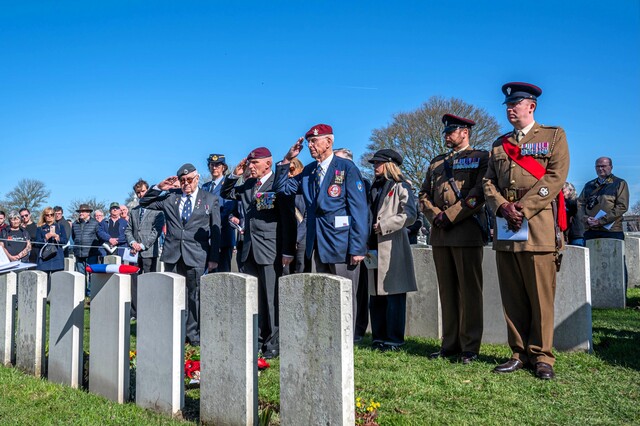
"[The remains] are buried in the closest appropriate cemetry to where they fell, so in this case Private Detmold will be buried in Loos British Cemetery in Loos-en-Gohelle in France, which is the closest to where the Battle of Hill 70 happened," said Dr. Lockyer.
Dr. Lockyer said she feels very privileged to have a job that means this much to families across Canada her work has affected.
"Being able to return the name, return the face, but also return that person and the concept of that person to the familes, some of whom have never heard of their relative before we contacted them, and some of them on the complete opposite of the spectrum knew exactly who we were talking about as soon as we reached out, it's quite something special to be a part of, and I'm incredibly grateful that I get to do this every day," said Dr. Lockyer.
Since the official creation of the Canadian Armed Forces Casualty Identification Program, 48 sets of remains from the First and Second World Wars and others have been identified.