Have you ever heard of Chronic Subdural Hematoma? It's a type of brain bleed that most often happens after a small head injury. It's also more common in older people taking blood thinners. Once treatment is given to patients with CSDH, there's a pretty high recurrence rate of 28%. But thanks to groundbreaking new research from a Winnipeg team, a new treatment could almost completely solve that problem.
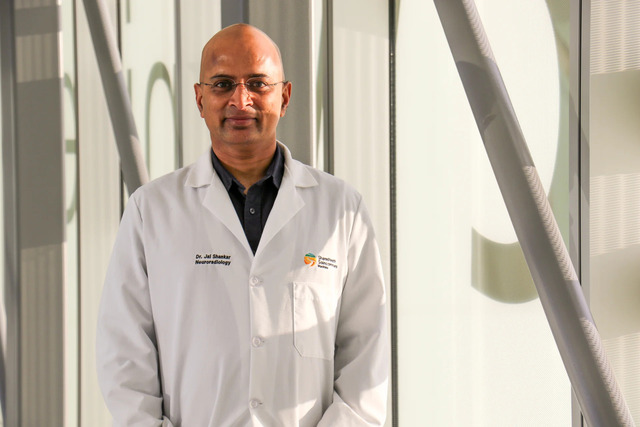
Meet Dr. Jai Shankar, Professor of Radiology at the University of Manitoba. His team has used a procedure called Embolization of the Middle Meningeal Artery - or EMMA for short - to treat patients after receiving treatment for CSDH.
"Patients who are having a minor head injury, and likely are on blood thinners, they're also more likely to get this, but what we do know is how it forms, and when it forms, what happens...Chronic Subdural Hematoma is brain bleed on the surface of the brain, and the covering of the brain is supplied by a tiny artery, where the Chronic Subdural Hematoma forms. So what we do is reduce the vascularity of the covering of the brain by blocking those blood vessels using glue-like substance," said Dr. Shankar.
The study saw Dr. Shankar's team run a randomized clinical trial of 186 patients at 9 different facilities across Canada. All of these patients were given the EMMA procedure after receiving surgery to treat CSDH. Dr. Shankar's team saw that the EMMA procedure reduced the brain bleed recurrence rate to 4%. That's going down from roughly 1 in 4 people, to 1 in 25.
With this treatment from our study, what we found is we could reduce the risk of this bleed coming back from 28% to only 4% when we added this new treatment to the patient," said Dr. Shankar.
At face value, even if you don't understand the specifics of the research, that's a big deal. The details of the study make it even more groundbreaking: no matter who completed the procedure at the 9 different Canadian hospitals, it went well.
"When you do a study or a treatment across multiple sites, and treatment is done by multiple operators, that tells us that no matter who does the treatment, the results will be the same...we also found that this treatment is very safe in any centre across Canada, and in any expert's hand, this treatment was very safe, so it was very effective and very safe," said Dr. Shankar.
Dr. Shankar's study was recently published in the Journal of the American Medical Association, or Jama. It's widely considered one of the top 3 medical journals in the world for peer-reviewed research and studies. That goes to show how much of an impact the team's work will have across the world.
"The acceptance in JAMA itself shows the global impact of the results of our study, not only locally in Winnipeg or Manitoba, but also across the country, and now it's going global. So it is literally having global impacts on the care of patients with Chronic Subdural Hematoma," said Dr. Shankar.
Dr. Shankar's team is currently at the Information Dissemination stage of their research, spreading the study as far as possible to get as much feedback and criticisms as possible, as a way to find how they can make their treatment even more effective. Click here to read the study in the Journal of the American Medical Association.