NewsNow
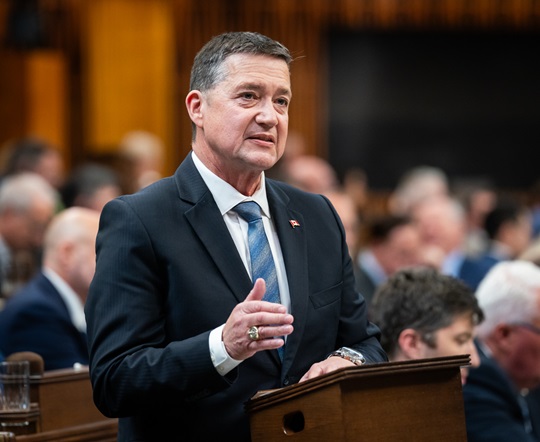
Riding Mountain M-P Dan Mazier has a new role within Pierre Polievre's federal Conservative shadow cabinet.
Mazier has been appointed Official Opposition Shadow Minister for Government Transformation, Public Services, and Procurement.
"It is (responsible) for everything that the government buys, all o the business transactions that go through the federal government, any kind of bidding processes, anything to do with government operations. That includes the post office, the review of 24 Sussex Drive, National Capital Commission of course. It is very much focused on government spending."
Mazier previously served in the role as Official Opposition Shadow Minister for Health.
- Details
- Contributed by Jeff Henson

Homecoming is something Gilbert Plains residents haven't had since 2016, so there's no way they were going to let mother nature delay it even more. One of the Parkland's cornerstone events, Homecoming sees a lot of street vendors, food trucks, and community, at the same time as the Grandview Ag Society Fair & Rodeo, to make the week that much better.
Bryanne Bates, Marketing Coordinator for Gilbert Plains Homecoming, said attendees can still expect a packed schedule this year.
"Homecoming is something that happens not every year, so far it's kind of been a every ten year thing, the last time we placed Homecoming events in Gilbert Plains was 2016, so it's been ten years since our last event like this...Friday we're still going to have the Ag Society Parade and our main street dance, where [attendees] can hear both live and played music, as well as a chainsaw carving auction," said Bates.
Some of this year's events include pancake breakfasts Thursday through Saturday, Thursday's Street Market at the Community Hall from 11:00 AM to 7:00 PM, the Grandview Ag Society Parade at 3:00 PM on Friday, and Saturday's Classic Car Show at the Elementary School Ground from 12:00 PM to 3:00 PM. Click here to view a full updated schedule for Homecoming.
Despite lots of setbacks and complications due to flooding and heavy rainfall recently, and a State of Local Emergency being declared in Gilbert Plains, the event is still expected to take place. Bates said she feels that's just what the community needs right now.
"We have to take very little off of our schedule due to the recent flooding, so that's really exciting that we were still able to put on a lot of the big events...we thought Gilbert Plains maybe needed a day or two to come together and maybe stop thinking about the flooding, and just come together as a community and work together, and maybe just bring some hope back," said Bates.
Gilbert Plains Homecoming is set for Wednesday, July 8th through Sunday, July 12th, featuring a lot of events, in all corners of the town.

- Details
- Contributed by Ian Gillingham

Several local organizations benefited from the Grandview and District Community Foundation's spring grants.
Through the Thomas Sill Manitoba Fund, the ice plant project at the GACC and curling rink received $22,264.10. Thomas Sill was a chartered accountant with several offices in Manitoba. The Foundation began in 1987 when he passed away, and became one of Manitoba’s largest private charitable organizations.
When it closed in 2023, the assets of the Thomas Sill Foundation were provided to the Winnipeg Foundation to create funds that would carry on Sill’s legacy of giving.
Each community foundation in Manitoba receives a grant every year to carry on Sill’s good work.
Chicks with Sticks, which is a women's hockey team featuring players from Gilbert Plains and Grandview, received $1,917.20.
In total, the foundation gave out more than $40,000.
"Well, it's pretty amazing actually. Everything stays locally, so we continue to see growth within our community," said Renee Minshull. "Organizations build on things they already have or need."

In its fourth year, the foundation hosts a community BBQ at Wilson Park. It's always very well attended. This year, an incredible $6,438.95 was raised.
The funds were donated to Tiny Treasures Children's Centre. The funds will help purchase infant-safe outdoor play equipment.
Minshull thanks everyone for coming out to the BBQ and being so generous.
"Every year, our community surpasses the previous year," she added. "This year was the highest amount that we collected during that BBQ."

$4,000 was given to the Grandview Swimming Pool. The funds were used to purchase Boga Boards.
The Grandview & District Resource Council received $2,632.00 to be used towards the purchase of new lifeline units.

The Grandview Hospital received $6,000, while the Grandview Personal Care Home Activity Department received $1,119.85. The funds will be used to purchase outdoor umbrellas and stands.
The Foundation looks forward to seeing the Personal Care Home's residents outside enjoying our beautiful Manitoba summers.
"That one was nice to see," ended Minshull. "Something a bit different than things inside the building that they required."
Dalayna Tomlinson was the winner of the post-secondary bursary. She received $1,000, which was then matched with $1,000 to the swimming pool in Grandview.
Since the Grandview & District Community Foundation was founded, they've provided more than $500,000 in donations to community organizations.
That's community spirit at its best. That's an organization that prides itself on giving back to organizations that keep the community thriving and a place to call home.

- Details
- Contributed by Darnell Duff

A 28-year-old Dauphin man faces charges after another man was hit with bear spray.
RCMP say the incident occurred last Saturday just after 6 am outside of a home on 8th avenue North East
They say the 36 year old male victim was walking home when an individual known to him rode by on a bicycle and bear sprayed him.
The victim was taken to hospital for treatment.
The following night, Mounties located a suspect and arrested him without incident, finding a can of bear spray inhis possession while conducting a search.
Charges against Jareth Chartrand include assault with a weapon, possession of a weapon for a dangerous purpose, and carrying a concealed weapon.
- Details
- Contributed by Jeff Henson

The City of Dauphin says they're receiving reports of residents getting scam calls, from people posing as insurance adjusters after recent flooding.
Never give your banking or insurance information to callers or visitors you don't know, or can't verify. If you're unsure, ask for identification, or contact the company directly via the phone number on their website.
More often than not, if something sounds too good to be true, it is. Always be cautious of people telling you to make quick decisions or ask for immediate payments. If something feels off, end the conversation, or hang up.
If you feel you've been targeted by a scam, the Canadian Anti-Fraud Centre can be reached at 1-888-495-8501, and the RCMP at 204-622-5050.
- Details
- Contributed by Ian Gillingham
A Manitoba teenager accused of conspiring online with a youth in Nova Scotia to commit simultaneous attacks at their rural schools has been denied bail.

The 14-year-old boy from Rivers appeared by video in Brandon court this past week where he was told that he would have to remain at the Manitoba Youth Centre.
The youth is facing charges of conspiracy to commit murder, counselling the offence of murder and uttering threats.
The boy was charged earlier this year, after police in Canada received information from Interpol and the FBI that the two teens had been talking online about their desire to attack schools in Rivers and Bridgewater, N.S.
- Details
- Contributed by Jeff Henson

The City of Dauphin's Waste Disposal Site remains open, with the City waiving fees for flood damaged items for Dauphin residents. To qualify, you need to provide your City of Dauphin address.
The City is also doing a pass through on Monday, July 6th to pick up flood-damaged material. They ask residents to place any flood-damaged material on your boulevard, as close to the curb as possible. If they can't get it all in one pass, they'll continue collection until it is complete.
Additionally, the City announced that residents are now able to use water again for essential hygiene needs, but still requests that residents continue to limit water use for non-essential water-intensive tasks, like laundry, dishwashers, and washing vehicles.
- Details
- Contributed by Ian Gillingham

Manitoba Parks has provided an update for those stuck at certain campsites in Duck Mountain Provincial Park.
The update reads as follows:

- Details
- Contributed by Alec Woolston

A Crane River man faces several charges following a scary incident in that community.
RCMP in Ste Rose responded late Sunday afternoon to a report that an armed man had come to a house and threatened to harm the father of someone who lived at the home.
He fled that scene in an SUV, but was spotted entering another home in the community, carrying both a handgun and a rifle.
Several other RCMP sources were called in to assist, and the suspect eventually left the home at around 11:20 that evening and was arrested without incident.
18-year-old McGlare Campbell faces several charges of possession of a weapon, as well as one count of uttering threats.
- Details
- Contributed by Jeff Henson
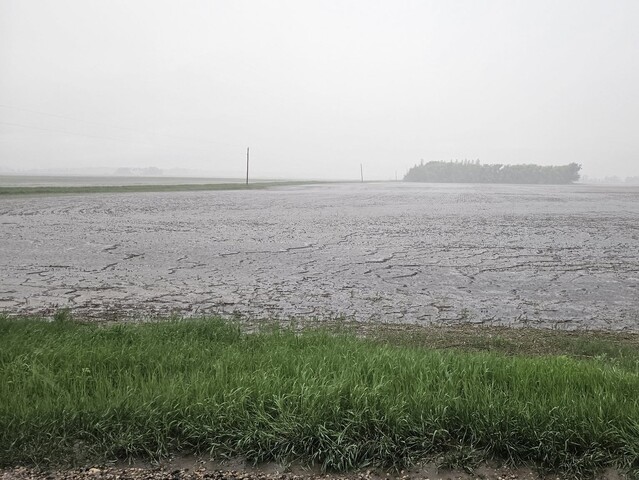
After recent severe flooding in the region, the majority of Parkland farmers and ag producers are dealing with widespread crop destruction and field disruption, on a scale that hasn't been seen in a very long time.
Ron Kostyshyn, Dauphin MLA and Manitoba's Agriculture Minister, recommends farmers and ag producers to review their MASC policies, or reach out to their local MASC office.
"Our first line of defence is crop insurance, and until we get some evidence-based information, we'll have some measurement how bad crops have been affected," said Kostyshyn.
Kostyshyn said MASC and AgriInsurance officials will, when it's safe to do so, start visiting farms and fields in the region to get a better picture of this disaster's scale for farmers. Until then, there's no way to accurately estimate damage totals.
One of the big concerns for this flood is unseeded acreage. The MASC seeding deadline for excess moisture coverage was June 20th. With recent rains and flooding making a lot of farmers unable to seed by that deadline, and now that ability getting pushed even further back, many Parkland farmers are worried.
"For the producers that weren't able to seed due to wet acres, there is a crop insurance premium, or opportunity of a premium, where they would receive $75 an acre for compensation because they were unable to seed, so that's one of many programs...given the damage that exists, we have no straight answer of what's going to become of it, but obviously crop insurance agents will be out, doing an assessment," said Kostyshyn.
For more details, click here to visit MASC's webpage on excess moisture insurance. If you have any other questions or concerns about unseeded acreage and excess moisture insurance, call your local MASC office.
- Details
- Contributed by Ian Gillingham
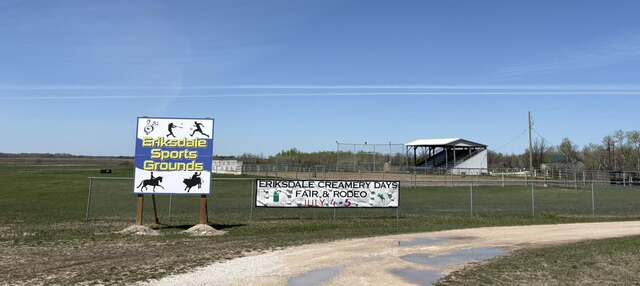
The Eriksdale Creamery is the local museum in the community.
It served as the community's creamery before closing in 1990. For those who aren't sure what a creamery is, it's a place where butter and cheese are produced.
Vienna Kinkead says the facility is still celebrated today.
That's where the Eriksdale Creamery Days, Fair, and Rodeo come in. The two-day event runs on Saturday and Sunday in the community.
"Saturday is our big day. We start with a pancake breakfast, followed by a parade, and we have events going on at the museum, which is open for tours," said Kinkead. "We offer live music from Shawn Mousseau this year. Then we head over to the sports grounds where we have our rodeo and tractor pull."
Kinkead stresses this event is for all ages. Saturday night ends with live entertainment by 'Lost in a Small Town'. On Sunday, the action heats up at noon with tractor pulls, a slo-pitch tournament, and the beer gardens are open at the sports grounds.
The rodeo begins at 1:00 p.m. on Sunday. Kinkead says the event is always a huge success, and her favourite part is you being a part of the magic.
"The entire weekend of seeing families get together, friends come out from the city, just watching everything that takes place," she added.
While the rodeo and kids' activities are always a big hit, it's the parade that is a home run. It starts Saturday at 11:00. The theme this year is 'Green and White'.
"Oh yes, the parade is hugely attended," ended Kinkead. "We have a great variety of floats. Tractors, horse wagons. And there is usually a ton of candy for the kiddos."
A weekend pass to enter the sports grounds costs $20 for adults and $15 for youth. Kids 12 and under are free when accompanied by an adult.
- Details
- Contributed by Darnell Duff